

As mentioned in our last blog, work zone safety is a must not only for the worker but for the public as well. Below you will see how the work zone in our last blog should have been set up according to the federal highway administration's manual on uniform traffic control devices. We have listed the link to the MUTCD manual for your information https://mutcd.fhwa.dot.gov/kno_2009r1r2.htm.
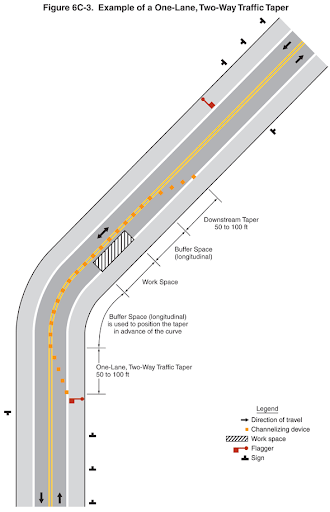
The figure below shows both directions of a highway with two lanes adjacent to each other traveling in opposite directions. Black arrows indicate the direction of travel on the roadway lanes, a yellow square denoting a channelizing device, a diagonally striped rectangle denoting a work space, red flags donating a flagging station and a short inverted "T" denoting a sign.
Arrows denoting direction of travel are shown in each lane. There are left and right shoulders shown outside of the two lanes, shown with a solid white edge line pavement marking that runs the full length of the figure.
The advance warning area is the section of highway where road users are informed about the upcoming work zone or incident area, which our real life situation did not have. This area may vary from a single sign or high-intensity rotating, flashing, oscillating, or strobe lights on a vehicle to a series of signs in advance of the TTC zone activity area.
< />
/>
On urban streets, the effective placement of the first warning sign in feet should range from 4 to 8 times the speed limit in mph, with the high end of the range being used when speeds are relatively high. When a single advance warning sign is used (in cases such as low-speed residential streets), the advance warning area can be as short as 100 feet. When two or more advance warning signs are used on higher-speed streets, such as major arterials, the advance warning area should extend a greater distance.
| Recommended Advance Warning Sign Minimum Spacing |
| Road Type | Distance Between Signs |
| A | B | C | |
| Urban (low speed) | 100 feet | 100 feet | 100 feet |
| Urban (high speed) | 350 feet | 350 feet | 350 feet |
| Rual | 500 feet | 500 feet | 500 feet |
| Expressway / Freeway | 1000 feet | 1000 feet | 1000 feet |
Since rural highways are normally characterized by higher speeds, the effective placement of the first warning sign in feet should be substantially longer—from 8 to 12 times the speed limit in mph. Since two or more advance warning signs are normally used for these conditions, the advance warning area should extend 1,500 feet or more for open highway conditions.
Typical distances for placement of advance warning signs on freeways and expressways should be longer because drivers are conditioned to uninterrupted flow. Therefore, the advance warning sign placement should extend on these facilities as far as 1/2 mile or more.


